← Return to Archive
Notes From the Severed Floor /
09
Document No.
TOOL-09
Filed
June 1, 2026
Author
K. Dabir (Outtie)
Department
Tools
Read Time
5 min read
Classification
DECLASSIFIED
Notes /
09
Tools

Ball Knowledge | A Free Digital Basketball Playbook for Smart Coaches and Smarter Players
The clipboard is outdated. Your whiteboard gets erased. Your team watches one YouTube breakdown and shows up to practice with half the information and none of the context. And most basketball knowledge online is built for the wrong audience entirely.
Naming the starting five. Ranking the greatest of all time. Debating trades. That is what 2K players and card collectors do. That is trivia. That is not basketball IQ.
Real ball knowledge is something completely different.

What actually separates good teams from great ones
The coach who wins is not always the one with the most talented roster. They are the one who knows how to use what they have. They see a mismatch two possessions before it happens. They design a play to get their best shooter one clean look in the most important moment of the game. They know which of their bigs can roll versus which one needs to pop. They put their players in positions to succeed by outsmarting the defense, not just outrunning it.
That is real ball knowledge.
And for players, it is the same thing. The player who understands why a play works moves before the ball arrives. They read the defense instead of reacting to it. They know that when the screen is set at the elbow and the point guard curls left, their job is to lift to the opposite corner before their defender can help. They do not have to be told. They already see it.
That kind of understanding does not come from watching highlights. It comes from studying how the game is actually constructed.

The problem with how plays are taught right now
Most coaches still diagram plays on whiteboards or clipboards with Xs and Os. The problem is that Xs and Os are static. They show where players start and where they end up. They do not show the timing. They do not show the angles. They do not show the moment when the screen hits and the defender has to make a decision.
Players nod in the huddle. Then they get on the floor and half of them are in the wrong spot because they could not visualize the play from a diagram. Especially younger players. Especially players who are still learning how all five positions interact.
Digital playbooks exist, but most of them are built for coaches with $500 software subscriptions and a full staff. They are not built for the AAU coach who has eight kids, one assistant, and thirty minutes before practice. They are not built for the 16-year-old who wants to understand what their coach is drawing up but does not want to ask again.
Ball Knowledge fills that gap. Free. Animated. Built so anyone who touches a basketball can actually see what is happening.

This tool is not about identifying players. It is about deploying them.
You are not here to memorize who runs what in the NBA. You are here to understand the principles behind plays that work at every level, and then apply them to the people on your actual roster.
Your point guard is quick but not a scorer. Your center can step out to the three-point line. Your two guard moves without the ball better than anyone on the team. Ball Knowledge shows you the plays that take exactly those kinds of strengths and turn them into advantages the other team cannot stop.
That is what this is about. Your team. Your personnel. Your competitive edge.

The 5 plays in the playbook
Horns Set — Two bigs at the elbows, shooters in the corners, point guard working off a high screen. Forces the defense to pick a poison. Best for teams with versatile bigs who can either roll to the rim or step out and shoot.
Pistol — A dribble handoff into a drag screen. Creates a downhill attack in two seconds. Beats switching defenses and trapping guards because the ball changes hands before the defense can load up. Best for teams with a guard who attacks downhill.
Floppy — Two shooters curl off staggered screens in opposite directions at the same time. Whichever defender loses focus, that player gets an open look. Best for teams with multiple perimeter threats who move well without the ball.
Drag Screen — Early offense pick-and-roll before the defense is set. The trailing big sets the screen in transition, giving the point guard a step before the defense can recover. Best for teams that push pace and have a big who can run the floor.
Spain PnR — A high pick-and-roll with a back screen added on the roller's defender. Three things have to go right for the defense to stop it. At least one of them usually does not. Best for advanced teams with a big who can read the lob and a point guard who can make all three reads.

How to use Ball Knowledge
Step 1 — Enter your info. Add your name, email, team name if you have one, and whether you are a player, coach, or fan. Your access is free. No credit card. No subscription.
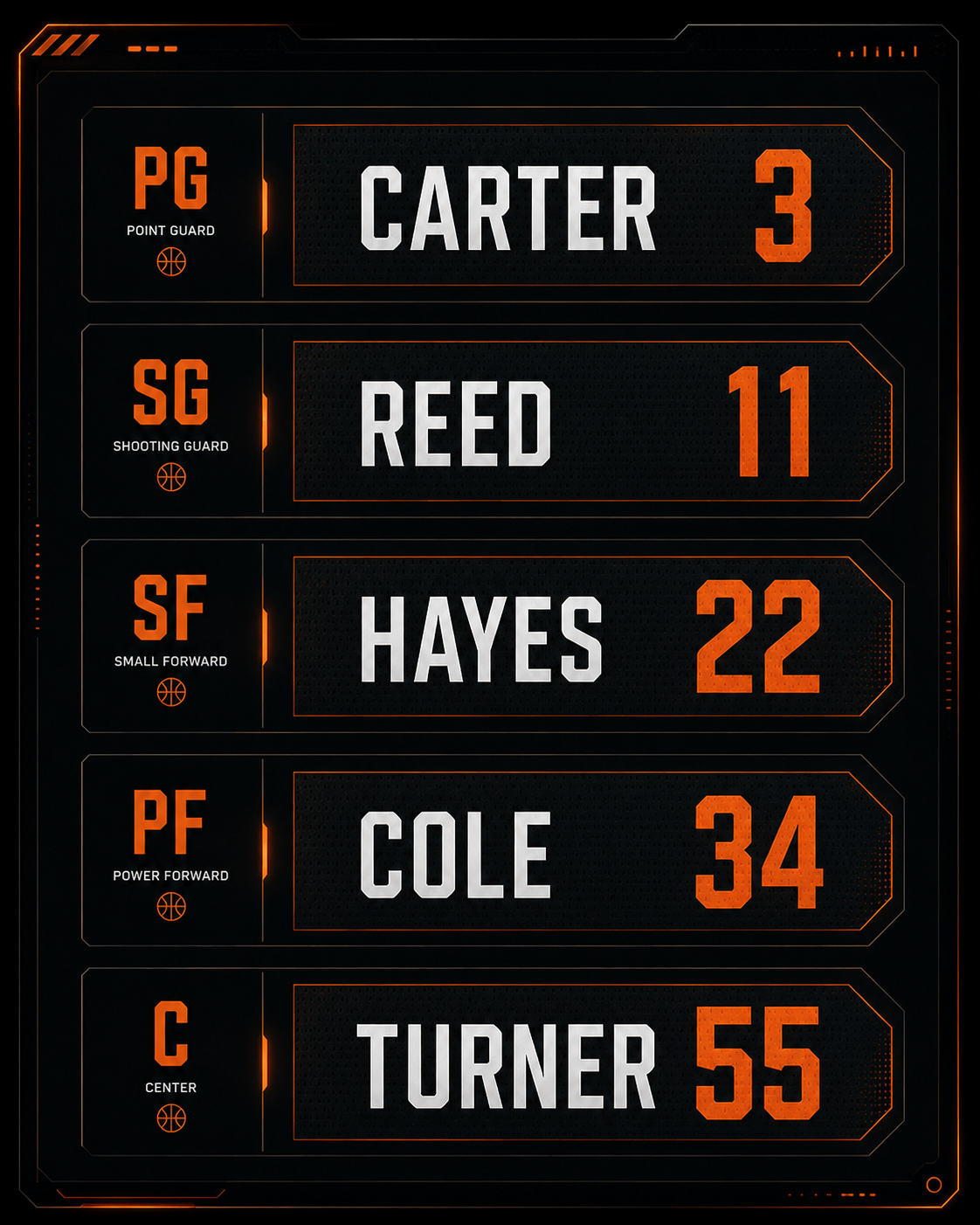
Step 2 — Build your roster. This is the part that makes the tool yours. Add all five players by position, name, and jersey number. Point guard through center. Your players will show up on the court as themselves, not generic markers. A coach can set this up for their actual team before a practice session and use it as a teaching tool on the spot.
Step 3 — Pick a play. Choose from the five plays in the playbook. Each one comes with a thumbnail preview so you can see what kind of movement it involves before you run it.
Step 4 — Hit Run Play. Watch your five players move through the play in real time with beat-by-beat coaching captions. See the screens set, the arrows drawn, the cuts made. Every phase of the play is labeled so you know exactly what is happening and when.
Step 5 — Slow it down. Hit the 0.5x button to run the play at half speed. This is where you study the timing. This is where you catch the second cut that happens while everyone is watching the ball. This is where plays make sense in a way that no whiteboard ever could.
Step 6 — Read the breakdown. Below the court, every play has a What is it card and a Why it works card. The first tells you the structure. The second tells you the defensive problem it creates and why it is difficult to guard. Understanding both is how basketball IQ actually builds.
Step 7 — Edit your roster anytime. Come back the next day before practice. Update the lineup. Try a different five. The tool saves your last roster so you are not starting from scratch every session.
More plays are coming. This is a living playbook.
Next in Archive
.svg)