← Return to Archive
Notes From the Severed Floor /
010
Document No.
NFSF-004
Filed
May 18, 2026
Author
K. Dabir (Outtie)
Department
Notes From the Severed Floor / 004
Read Time
15 minutes
Classification
Opinion
Notes /
010
Notes From the Severed Floor / 004

Audemars Piguet x Swatch at Valley Fair: What the Royal Pop Frenzy Tells Us About Legacy Brand Marketing

I live in the Bay Area. I drive past Westfield Valley Fair on Stevens Creek Boulevard a few times a year.
On Saturday, May 16, 2026, the Swatch store inside that mall shut its doors for the day.
Not for a fire alarm. Not because of staffing. Because the crowd waiting to buy a $400 pocket watch had grown big enough that Swatch corporate, working with San Jose police on crowd management, decided public safety mattered more than the day's sales.
The watch is the Audemars Piguet x Swatch Royal Pop. It is one day old. It is a partnership between a Swiss luxury watchmaker and a Swiss mass-market plastic watch brand. Eight colorful pocket watches in Bioceramic*. $400 to $420 each. One per person per store per day. The same scenes played out in Dubai, London, Lyon, Singapore, and right here in the South Bay.
For anyone watching legacy luxury brands try to stay relevant in 2026, the Royal Pop is one of the most instructive case studies of the year.
Here is what is actually happening, why it matters, and what every marketer should take from it.
What the collab actually is
Audemars Piguet (shortened to AP) is the independent Swiss watchmaker behind the Royal Oak. The Royal Oak is one of the most recognizable luxury watch designs of the past 50 years.
Swatch is the Swiss mass-market plastic watch brand. The same group also owns Omega, Blancpain, Tissot, Longines, and a dozen other watch houses.
The Royal Pop is a collection of eight Bioceramic* pocket watches. They translate the Royal Oak's design language into a playful, colorful, pop-art format. They carry Royal Oak DNA. The famous octagonal bezel*. Eight hexagonal screws. A Petite Tapisserie*-style dial pattern. They also introduce a hand-wound version of Swatch's SISTEM51* movement, a world first.
The relevant facts:
- Released May 16, 2026, in-store only at selected Swatch boutiques worldwide
- $400 for hours-and-minutes versions, $420 for small-seconds variants
- Limited to one watch per person, per store, per day
- Wearable as a pocket watch, a pendant, a bag charm, or a desk clock
- 100% of AP's proceeds from the collaboration are going to watchmaking apprenticeships and scholarships
- One of the 21 participating US boutiques is Swatch at Westfield Valley Fair, 2855 Stevens Creek Blvd, Santa Clara, CA 95050
Why AP is doing this
The official line from AP CEO Ilaria Resta is simple. Audacity is often the starting point of innovation. The collab invites a broader audience, including younger generations, to experience mechanical watchmaking differently.
That is the surface answer. The deeper logic is more interesting.
AP is independent, and that makes this strategic rather than internal. Every previous big Swatch collaboration kept the partner inside the Swatch Group corporate family. MoonSwatch with Omega. Mission to Earth. Scuba Fifty Fathoms with Blancpain. The Royal Pop is the first time Swatch has reached across the table to an independent luxury brand. For Swatch, that is a coup. For AP, that is a deliberate brand decision, not an internal handshake.
Resta is reframing what AP stands for. She has publicly pushed against the idea that luxury watchmaking is conservative, male-dominated, and stuck in tradition. She has said on the record that 45% of mechanical watch buyers will be women by 2030. The Royal Pop is the most visible piece of that reframe. The pocket-watch-as-bag-charm format is a deliberate nod to younger and more cross-gender buyers. Analysts have pointed to Labubu-style charm trends as a clear influence.
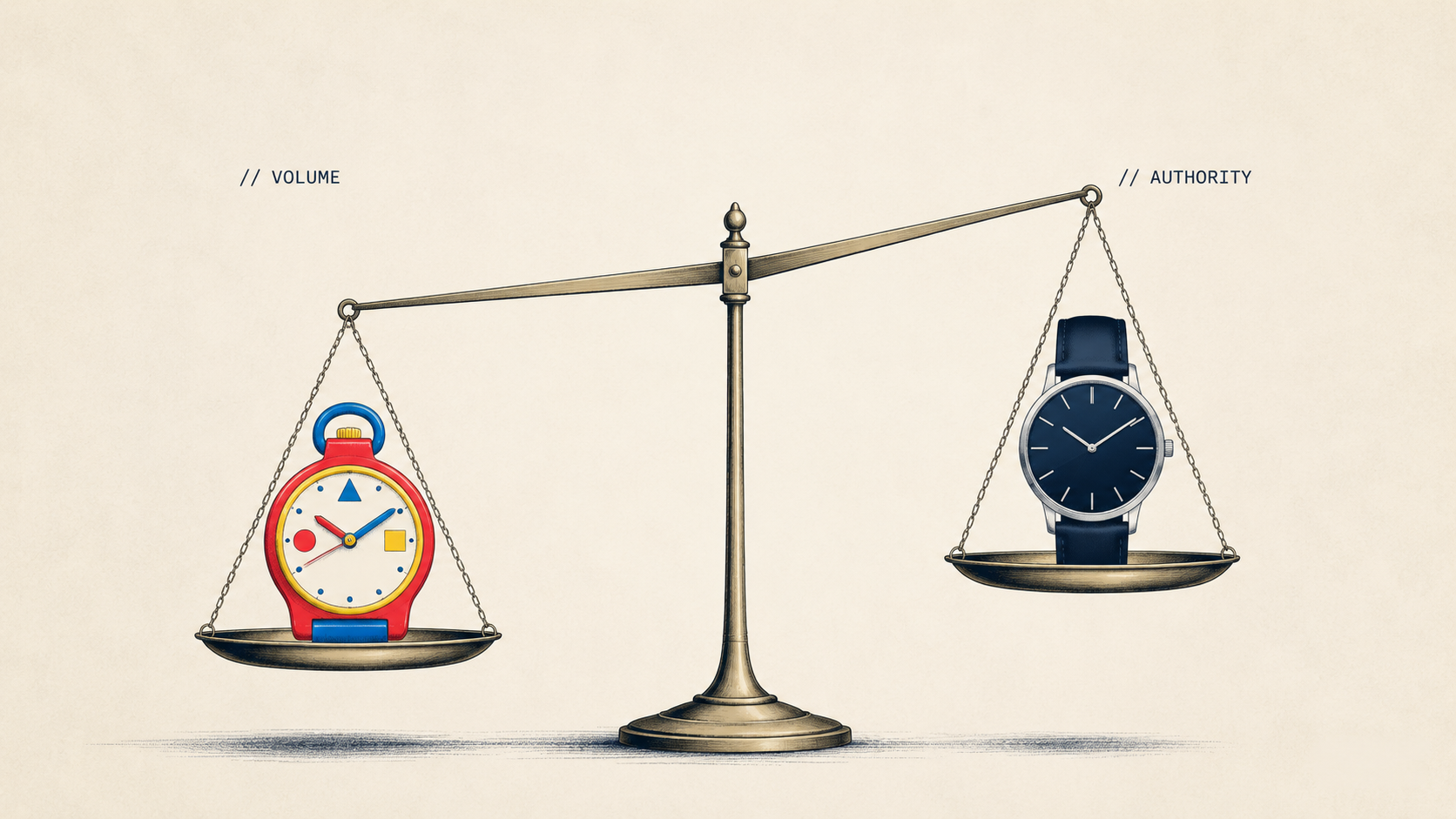
The collab is a brand authority* play, not a revenue play. AP does not make money from this in any real way. The collection is small. The price point sits orders of magnitude below an actual Royal Oak, which starts around $25,000 and goes well past $100,000 for the steel sport models. AP is also donating 100% of its proceeds back to watchmaking scholarships, so even the pocket watch revenue does not hit AP's P&L. The mechanic is not "sell pocket watches." The mechanic is: make AP relevant to a younger, broader, more cross-gender audience. Trust that some of those people end up in the buying tier for a real Royal Oak in 5 to 15 years.
Resta is one of the most interesting leaders in luxury right now. She is Swiss-Italian. She studied Latin, Greek, and philosophy. She originally planned to teach. A university marketing contest changed the path.
Here is the resume, in plain order.
Here is what matters for this story. Resta is an outsider to the watch industry. She came from consumer goods and fragrance, not horology. That outsider angle is exactly why she can make a call like the Royal Pop. She is not protecting watch industry orthodoxy because she did not grow up inside it.
The Royal Pop is a Resta call. It has her fingerprints all over it: cross-category, brand-led, audience-first, sustainability angle baked in. She is the most consequential luxury CEO not named Bernard Arnault right now, and she has been in the seat less than two years.
The MoonSwatch precedent and the problem with it
Everyone running this analysis points to MoonSwatch as the template. The Swatch x Omega collab launched in March 2022. It sold a million units in its first year. It is still drawing crowds for new variants today.
The financial numbers tell a more complicated story.
Per Morgan Stanley estimates cited by industry analysts, Swatch's annual revenue rose from CHF* 420 million in 2022 to CHF 474 million in 2025. Over the same three-year period, Omega's revenue declined from CHF 2.5 billion to CHF 2.2 billion.
The MoonSwatch worked beautifully for Swatch. It is a lot less clear it worked for Omega.
Collabs can be brand-elevating for the smaller party and brand-diluting* for the larger one. The Royal Pop is making the bet that goodwill, mindshare, and the "ignite collective desire" effects translate into long-term brand health, even if the short-term math is ambiguous.
Resta has already framed the Royal Pop as a one-off. One collaboration. One ambition. That is one way to limit the downside. If AP never makes a Royal Pop 2, 3, or 4, the audience cannot accuse them of cheapening the brand the way some collectors have accused Omega of being cheapened.
Not everyone is convinced. WatchPro's editor-at-large Rob Corder argued the Royal Pop is a misstep that misreads the market and the balance of risk and reward in producing anything that looks like a plastic Royal Oak. The skeptical case is real and worth holding alongside Resta's bullish one.
The other half of the Royal Pop deal is the person who built this entire playbook. Swatch Group CEO Nick Hayek Jr. is not new to luxury watch collabs. He has been running this strategy for over 20 years, and he is the architect of the MoonSwatch template everyone else is now studying.
Hayek is the person on the other side of the Royal Pop deal. Swiss businessman, born in Lebanon in 1954, son of the man who saved the Swiss watch industry. He has been Swatch Group CEO for 23 years.
Here is the resume, in plain order.
Here is what matters for this story. Hayek has been running this playbook for 23 years. The MoonSwatch was not a one-off creative idea. It is a repeatable strategy. The Royal Pop is the third major chapter: MoonSwatch with Omega, Scuba Fifty Fathoms with Blancpain, and now Royal Pop with AP.
What makes the Royal Pop different is that AP is not inside the Swatch Group corporate family. This is the first time Hayek has reached outside the company for a partner. That decision is his alone. The fact that he convinced Resta to say yes is the real story behind the queue at Valley Fair.
Why Valley Fair was always going to be a scene

The Swatch store at Westfield Valley Fair, 2855 Stevens Creek Blvd in Santa Clara, was always going to be one of the biggest US lines for this release. Alongside Caesars Forum Shops in Las Vegas and Queens Center in New York.
The line started days before the doors opened. San Jose police helped with crowd management at the mall. SJPD told local press there were no reports of violence. Just sheer volume.
The Bay Area is one of the densest luxury watch collecting markets in the country. Stevens Creek Boulevard alone hosts a concentration of luxury and premium retailers. Stanford Shopping Center sits 18 miles north in Palo Alto. The customer base pulls from San Jose, Sunnyvale, Mountain View, Cupertino, Palo Alto, and the broader South Bay tech corridor.
The demographic that lines up overnight in Santa Clara for a $400 pocket watch overlaps significantly with the demographic that buys a $40,000 Royal Oak at full retail.
That is not an accident on the part of Swatch or AP. Store locations for releases like this are chosen partly for foot traffic, partly for press optics, and partly for proximity to the next decade's actual buyers. Valley Fair checks all three.
Westfield Valley Fair closing for "public safety considerations" is not a marketing failure. It is a marketing feature. The headline writes itself. The social content writes itself. The local press coverage from NBC Bay Area, KTVU, and the San Francisco Chronicle carries the brand reach for free, in the exact geographic market where AP wants future Royal Oak buyers to be paying attention.
Four lessons for marketing teams
What to actually watch over the next 12 months
The Royal Pop launch is the headline event. The interesting data is what comes next.
- Resale prices. Royal Pop listings on Chrono24 and eBay opened well over $1,000 within hours of the launch, with European listings touching €1,500+. If they stay there for six months, the brand bet is working. If they crash to retail or below, the collab failed to create durable desire
- Royal Oak waitlist* movement. The real test for AP is whether the Royal Pop generates measurable interest in the actual Royal Oak from buyers who were not on its radar before. The data is internal but will leak through dealer commentary over the next year
- Younger and more female buyer mix. Resta has made this explicit. AP wants younger and more female buyers. The metric to watch is the demographic mix of new Royal Oak buyers in 2027 and 2028, not the Royal Pop sales themselves
- The "one-off" promise. If AP holds the line and never makes a Royal Pop 2, that builds collector trust and protects the brand. If they cave to demand and do another, the brand dilution* risk becomes real
- Bay Area secondary market*. Watch the South Bay specifically. Valley Fair was one of the largest US lines. Bay Area resale volume will be a meaningful signal of whether the regional buyer base sees the Royal Pop as a long-term hold or a short-term flip
For Bay Area marketers, founders, and watch enthusiasts
If you watched the line stretch around Stevens Creek Boulevard this weekend and wondered what was happening behind the scenes, the Royal Pop is a live case study in how a legacy luxury brand engineers cultural relevance.
AP did not run a TV ad. They ran a partnership that automatically generated global press, social content, and direct competition for attention against everything else launching in the same week. It cost them production runs of a few thousand pocket watches and the willingness to share the spotlight with a $400 plastic watch brand. It bought them more brand reach in a week than most luxury houses generate in a year.
Whether the bet pays off, only the next 12 months will tell. The strategy is real. The risk is real. And the queue at Westfield Valley Fair on Saturday morning was the most expensive piece of marketing real estate AP did not have to pay for.
If you are in marketing and want to compare notes on what makes a brand collaboration work or fail, message me on LinkedIn. If you actually managed to walk out of Valley Fair with a Royal Pop this weekend, I would genuinely love to hear whether you are keeping it on your desk or listing it on Chrono24.
Next in Archive
.svg)